Thursday, October 4, 2012

Some nice "Hidden Sector Photon" fieldplots

Some 3D plots I have done recently for a presentation. They were done with Python and Mayavi. They show how a hypothetical hidden photon field would look like. The emitting structure is a microwave cavity, with a strong electromagnetic field inside. This field is the driving force for the hidden photon field which can penetrate the cavity walls and propagate into space. Unfortunately you can not see the cavity geometry itself in these pictures.

You don't need to understand any of this, just enjoy the visuals...


Tuesday, October 2, 2012

A power amplifier for the serious garage door opener

While my serious garage door opener works nicely and reliably, it's output power is "only" 10 dBm (10 mW). It is able to open the garage door from about 100 m -- this is clearly not enough.

So I thought an impressive looking garage door opener needs an impressive amount of RF output power as well. And I found a wonderful solution to that problem, the SKY65116 chip module.

It provides up to 2 W of output power from 390 - 500 MHz, 30 dB of gain and its input and outputs are matched to 50 Ohm. In fact it contains a third matching circuit between the internal pre- and power-amplifier  It can be put into standby mode drawing only a few uA and thus can be left connected to the battery. When running at full blast it draws 1.2 A at 3.6 V, so its efficiency is about 50 %. Not bad at all!


Saturday, September 15, 2012

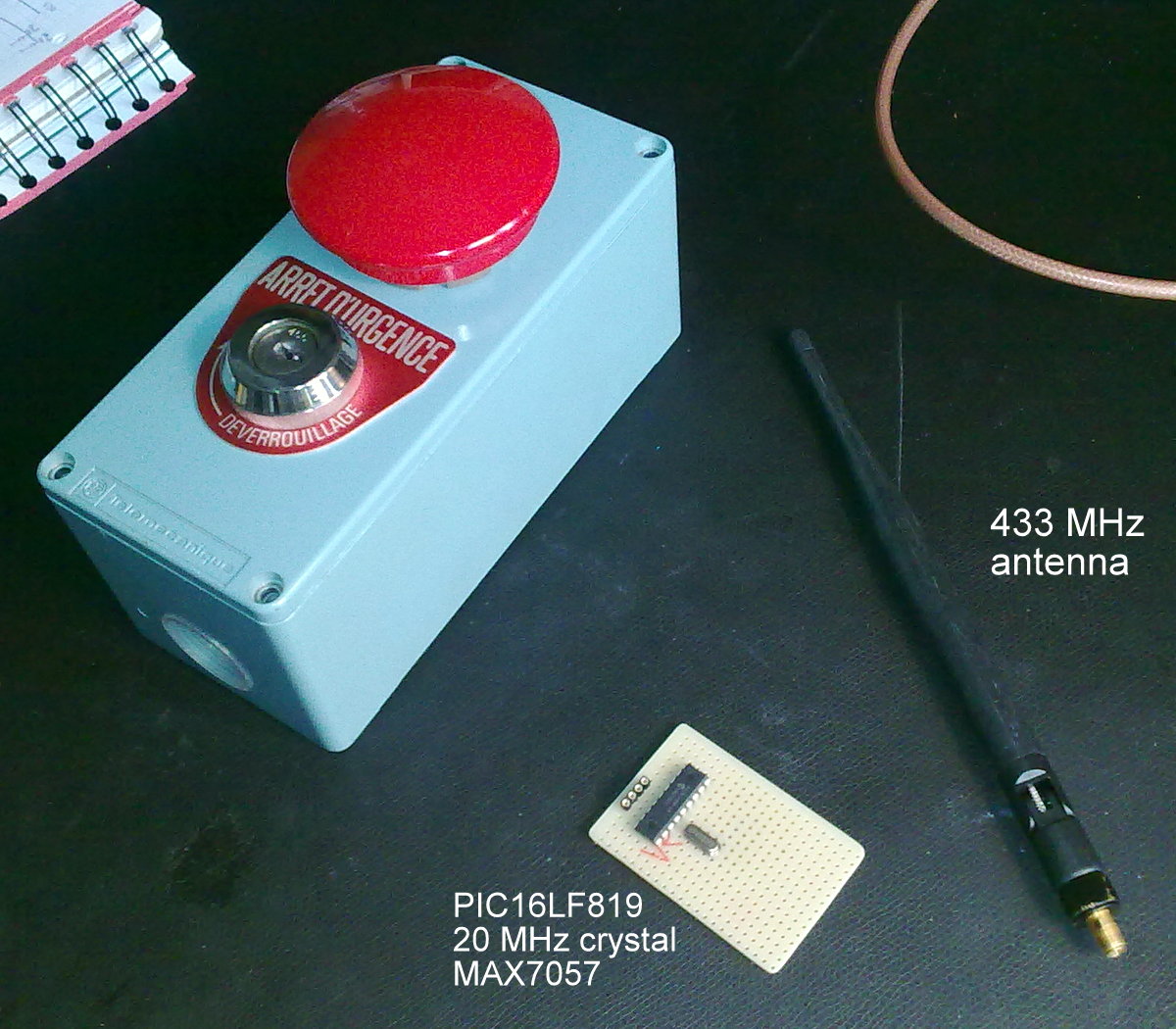
The serious garage door opener

Garage door openers are handy little gadgets. Most of them are cheap chinese plastic crap though. This one definitely isn't. It started by collecting parts from my favorite electronics shop: the dumpster.


An old emergency shutdown switch makes the perfect case with a seriously big red button.


Monday, March 26, 2012

PyAudio with 24 bit under windows

Here are the results, proofing that with the WASAPI architecture I got true audio 24 bit samples under Windows 7:

Sunday, March 25, 2012

PyAudio: How to get 24 bit support under windows


PyAudio is a really useful and user-friendly python extension for accessing the soundcard from python.

Pyaudio uses the portaudio bindings between some windows sound architecture and python. Only the WASAPI and the ASIO APIs on windows 7 support real 24 bit resolution. The standard version that comes shipped with pyaudio is compiled for WMME which is old and emulates win xp sound. It converts the 24 bit data to 16 bit and calculates with this precission internally. It returns 24 bit numbers but this is zero-padded16 bit data (can be seen as there is no change in the quantizing noise floor)

So pyaudio and portaudio needs to be rebuilt from source to support WASAPI. (or ASIO but you have to register at steinberg as a developer to get the SDK from there)

This is how I managed to build it:

Wednesday, February 3, 2010

Monday, October 12, 2009

Das Ausmaß der Software nimmt langsam Katastrophale Zustände an.
Die Kommunikation über das Obd Protokoll wird komplett über Interrupts gehandhabt und läuft transparent im Hintergrund ab. Ein kleiner Scheduler sorgt dafür, dass Werte regelmäßig über Obd abgefragt werden. Er bestimmt welche PID an der Reihe ist und informiert das Hauptprogramm über neu empfangene Daten.
Das Hauptprogramm kümmert sich dann um die Darstellung der Werte auf dem Display. Im Moment geschieht dies noch als Text / Balkendiagramm. Der Strukturierte Aufbau ermöglicht es allerdings ohne viel Aufwand neue Zeichenfunktionen zu schreiben.
Um das alles zu realisieren waren einige Klimmzüge notwendig und in der Source sind jetzt ein paar dicke Dinger drin. Z.b. Eine Statemachine, die sich über 3 verschiedene Interrupt service routinen erstreckt oder eine 3 fach verschachtelte Switch Case Anweisung :p
Egal, das ding tut.
Aktuelle Bilder stell ich später noch rein.

Hiermit möchte ich nochmal bei allen bedanken, bei denen ich Code geklaut habe :p
das wären im einzelnen:

  • Hagen R. für die Grafikfunktionen fürs Display und das ausgefuchste eventbasierte Menüsystem
  • Christian K. für das reverse engineering des Siemens S65 Displays
  • Elm Chan für die SD Karten Ansteuerung und die Bibliotheken zum FAT32 Dateisystem (soon 2 come)
  • Objective Development für den Firmware only USB Treiber (wird im Bootloader verwendet)